


If you want to truly support wildlife in your garden, it takes more than planting a few natives and pollinator favorites — it requires thinking like an ecosystem. My guest this week, landscape ecologist Dr. Shaun McCoshum, explains how mimicking natural habitats can transform even small garden spaces into thriving refuges for birds, insects and other wildlife, while still keeping them beautiful, productive and manageable.
Shaun helps us see gardens in a whole new way, not just as places we design for beauty and productivity, but as living, breathing ecosystems that can support far more life than we might realize. His new book, “Natural Habitats and Wildlife Gardening: Inviting Nature into Your Backyard,” challenges the conventional idea of what a well-kept garden should look like, and instead invites us to work with nature, not against it, to create spaces that are vibrant, resilient, and full of life.
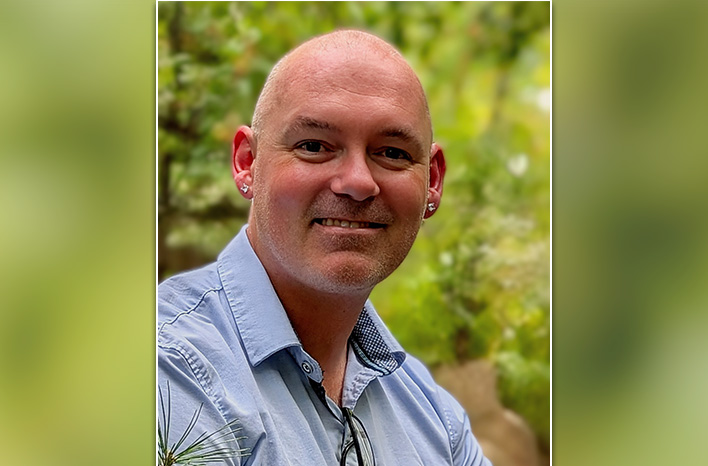
Shaun McCoshum, Ph.D., is a landscape ecologist and author. His latest book is “Natural Habitats and Wildlife Gardening.”
Photo Courtesy of Shaun McCoshum
I love Shaun’s book — the content, the practicality, and the look and the feel of it, with wonderful writing and photography. It’s like a field guide that you take out with you rather than leaving on a bookshelf.
In this conversation, we’re digging into what it really means to garden with wildlife in mind, from creating layered habitats and supporting biodiversity to rethinking some of the habits and expectations that may be working against the very nature that we’re trying to attract. If you’ve ever wondered how to make your garden not just a place for you but a place that truly gives back to pollinators, birds, beneficial insects and the broader ecosystem, this is a conversation that is going to open your eyes to what’s possible right outside your door.
Meet Dr. Shaun McCoshum
Shaun is currently a senior ecologist for an engineering firm in Corpus Christi, Texas. His background is largely in ecological restoration and building habitats.
“ I’ve been accidentally doing it since I was a kid,” he shares. “My grandma got me into gardening when I was early on. We actually became poor when I was in about second grade, so gardening became a mainstay for us to eat.”
In California at that time, there were still many laws preventing front-yard food gardens. So Shaun’s family had to tuck food-producing plants away and make them look pretty.
Shaun earned a bachelor’s degree in biology from Humboldt State University in Arcata, California. He did conservation work on Catalina Island, southwest of Los Angeles, and in Mount Charleston outside of Las Vegas, then earned a master’s degree in botany from Miami University in Oxford, Ohio. After working in Wisconsin, he went on to earn his Ph.D. in landscape ecology from Oklahoma State University in Stillwater, Oklahoma, with research focused on pollinator communities and how agricultural systems are affecting native bee communities.
As a side project that could have amounted to its own Ph.D. research, Shaun studied monarch butterfly ecology. He has also done work in reef ecotoxicology to see how sunscreen is affecting reef biota and how tourism is affecting habitats. He proceeded to do postdoctoral studies at Cornell University in Ithaca, New York, on native bees and solar facilities and began managing preserves in New York.
Throughout his work and studies, Shaun has volunteered with land trusts to help parks and landowners figure out ways they can help pollinators and amphibians and how they can be more connected with nature in their own backyard.
Natural Habitat Gardening and Wildlife Friendly Gardening
“ When we are trying to recreate spaces in our gardens, we want to typically mimic what’s happening in nature,” Shaun says. “And the best way to do that is to understand what should be happening, what regulated these spaces.”
Quite often in wildlife gardening and pollinator gardening conversations, you hear things that actually go against what would be happening in nature, according to Shaun.
“One thing that I constantly hear is, ‘Let your yard be. Let nature take its course,’” he says. He presses people to think about and explain what they mean when they say that.
In an intact ecosystem, large mammals are present and there’s not a lot of dead standing vegetation from the previous growing season left by the time the ecosystem is two months into a new growing season. But in an unmanaged urban lot, there is a lot of dead vegetation still standing because there are many missing components that are required for nature to take its course.
“ We have to step in if we’re managing these spaces and start mimicking the bison, the bears, the elk, the moose, the groundhogs — whatever animals existed in our areas that were, in fact, managing these ecosystems. And then if we can replicate those, then we can actually create much better habitat for the wildlife inside of our gardens.”
Even better, he says, is that we can make those gardens gorgeous for ourselves and produce food while still promoting nature inside of our gardens.
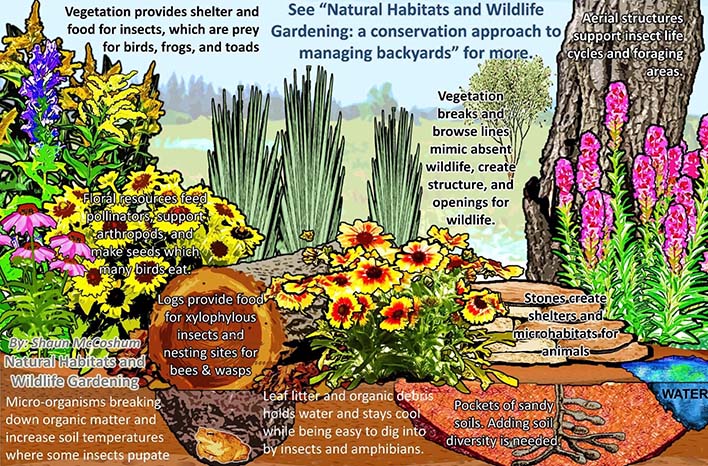
Features of a garden designed to mimic a natural habitat. Photo Courtesy of Shaun McCoshum
Mindset Shift
For a conventional gardener, adopting wildlife gardening requires a mindset shift.
“If I was having this conversation with somebody who started gardening because they loved roses and had a collection of roses, the first thing I would tell them is, if you want to start supporting pollinators and wildlife, we have to be comfortable with our plants being damaged,” Shaun says. “So that means leafcutter bees cutting holes out of the rose leaves, cucumber beetles eating some of the petals. That’s OK, because those insects are important for the overall ecosystem.”
For gardeners who are further along on their ecological gardening journey, such as those who have converted their lawns into all native plants, he suggests what they can do to help pollinators, particularly moths and beetles, to get through the winter.
Consider where animals go to avoid freezing to death or to avoid drying out, he advises.
Typically, overwintering animals are looking for rich organic matter that replicates the breakdown of stumps or fallen logs.
“We want to make sure we’re diversifying the soils inside of our gardens, because typically we’re focused on soils for plants, but many of our wildlife also need specific soils,” Shaun says.
Common snapping turtles, for example, need piles of loose organic mulch. In the wild, this would typically be in a big fallen tree that is decaying. In a developed area, this could be in a wood chip mulch pile.
Creating small pockets of soil diversity — as tiny as the size of a 1-gallon container — in our gardens can support various wildlife.
Rich organic matter can support crickets, lightning bugs and moths, Shaun says. “They’re not built for digging, but they need to be able to get out of the elements and into something that has some thermal insulation and moisture gradient to keep them safe.”
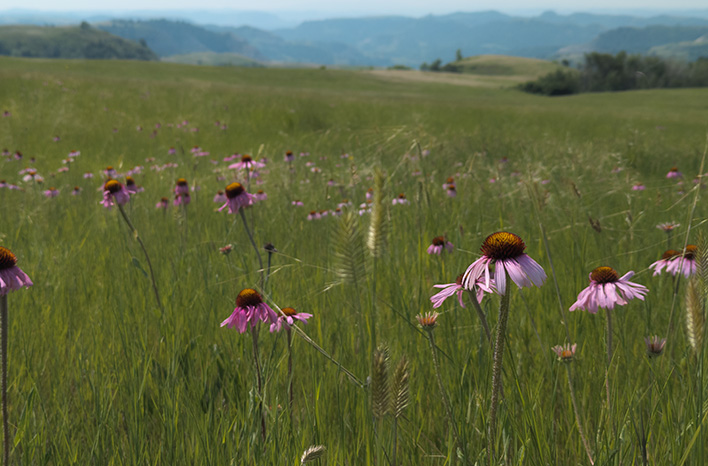
When your garden mimics natural habitats, expect that your plants will become food for insects. Learn to tolerate the damage. Photo Courtesy of Shaun McCoshum
The Importance of Snags
When resetting a vegetation community, the new community can benefit from the resources leftover from the previous ecosystem, Shaun explains.
“ When something is disturbed, be it from floods, fire, drought, major insect breakouts, whatever it was, there would still be all of these resources that are left over,” he says.
Standing snags and fallen logs are incredibly important for wildlife, he notes.
In the 1990s, bluebirds were declining across North America because humans had removed their nesting resources. “The very few ones that were still intact were being outcompeted by starlings, which are an invasive bird,” Shaun notes.
Farmers and landowners were able to reverse bluebird decline by installing nest boxes, which are now widely available. The boxes have the hollow cavity that bluebirds require to raise their young.
An Easy Place to Get Started
“People do need a to-do list,” Shaun says. “They need simple, packaged things that they can do.”
He tried to make sure that every project he describes in his book can be completed in less than two days, and many of the projects can be done in less than two hours.
“ Stack some rocks up with some space,” he suggests. “Add an excavated area to a raised bed that has an entrance for anything that needs to get out of the sun or out of the cold. And add pockets of organic material. Just as fast as planting a plant, you can excavate some soil, put in some untreated wood chips and little bits of soft sand, and you’ve started to diversify that soil to really help the arthropods inside of our landscapes find new places to shelter and lay their eggs.”
The 50° Fahrenheit Rule Is Not What You Think
The 50° Fahrenheit rule (or 10° Celsius rule) states that you should not disturb your garden or landscape until the temperature has reached that threshold in spring, because that’s when creatures wake up from their winter dormancy.
Shaun says he first heard of this rule from a herpetologist — a scientist who studies amphibians and reptiles.
“ Somewhere along the line, it’s just gotten misconstrued that 50° Fahrenheit is when insects emerge, and that’s not the case at all,” Shaun says. “The reason we should be waiting for 50° Fahrenheit is so that skinks are actually in a capacity — a regulatory metabolism — that they can move and find a new shelter.”
Disturbing a rotting log will lead to some mortality of eggs or pupae that are stuck there, but the majority of reptiles, amphibians and adult arthropods will be able to find new shelter and continue to succeed in their lifecycle, he says.
For someone in the Atlanta area like me, Shaun suggests waiting until the air temperature is 60 or 65° before disturbing logs and timbers, because that’s the temperature when anoles will be active.
“In areas like New Mexico,” he adds, “I actually recommend to go a little bit higher, 75 or 80°, because those lizards are used to being active at much higher temperatures. So some of them are still very lethargic in the 60s and 50s.

When things warm up in springs, all sorts of wildlife comes out of dormancy. Photo Courtesy of Shaun McCoshum
Why Managing a Landscape Becomes Necessary
“ Tidying up, cleaning and messiness, those are words that I really dislike, but unfortunately the ones we have in our toolbox at the moment,” Shaun says. “ But to replicate the big animals that existed in our landscapes and are no longer present inside of our urban landscapes, we do, in fact, need to clean up and tidy up.”
He likes to call it “managing spaces appropriately,” and he urges gardeners to keep all that organic material on our properties rather than bagging it up and hauling it away.
Maple or oaks leaves that will smother low-growing plants like frog fruit should be raked away, but moved elsewhere on your property rather than disposed of.
Shaun points out that it is possible to put down too much leaf mulch. In an area where full-sun meadow plants grow, there should only be an inch or two of leaf mulch. If there is too much leaf cover, the rain and snow will compact the leaves until they are like cardboard and will prevent plants from growing up from underneath.
“ Those leaves do need to strategically be placed back underneath the tree itself or underneath shrubs that are going to be tall enough to already be exposed to the lights to continue to photosynthesize,” he says.
Large Mammals Help Birds Eat in Winter
“Wolves, elk, deer — any of the active summer mammals — they clear snow and they also clear the leaf litter,” Shaun notes. “So they’re trying to get down to the chutes and the roots of those plants. And in doing so, they’re exposing the soil for birds to come in and actually access that seed bank. So when we’re thinking about cleaning up snow, one of the things that we should be thinking about is in our meadow spaces where we have those full-sun plants, it is useful to go out and clean up some of that snow and expose some of that soil simply to help feed the native birds that are in the area that need to be able to access the seeds, but also the invertebrates that would be in that layer and they can still get the protein that they’re looking for.”
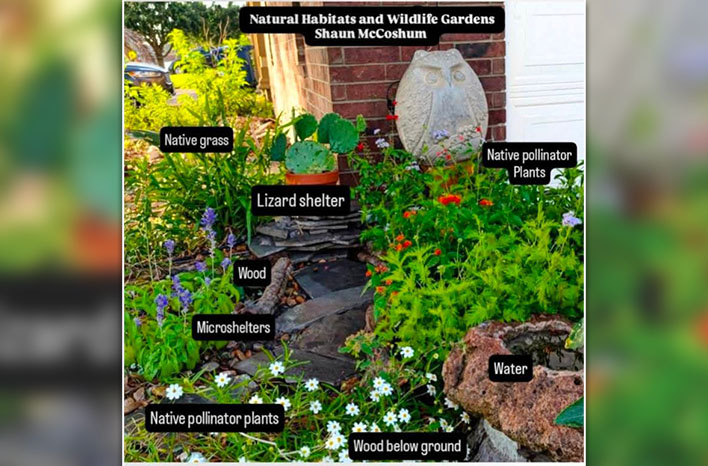
Small spaces can easily be transformed into ecologically valuable wildlife shelters. Photo Courtesy of Shaun McCoshum
Intervening to Supply Wildlife with Water
In 2026, about 75% of the United States is entering the growing season in a drought.
“ We are going to have incredible periods of drought that are going to push populations into extreme stress, decrease their survival rates, and there is no reason that we should be letting that quote-unquote ‘natural process’ continue because we’ve exacerbated it with climate change,” Shaun says. “So when possible, we should be providing some supplemental water during drought periods.”
He says water should be provided at ground level so more organisms can access it, and it should be spread out so birds that need open areas to feel safe can access that water. It should also be placed in sheltered areas so it can be accessed by animals that don’t want to be exposed.
In his book, Shaun shares designs to use your house’s downspouts to channel water away from the foundation and into ponds.
Mosquitoes breeding in pondwater can be controlled with Bacillus thuringiensis israelensis, a biological control that is commercially known as Mosquito Dunks. “ Our tadpoles, our dragonflies, the majority of things that live in that aquatic system are still able to persist and not be harmed by that,” Shaun points out.
Shaun also likes using old ashtrays from Goodwill for water sources because they dry out so quickly between refills that they will never breed mosquitoes.

Providing a pond or another water source will greatly assist struggling wildlife. (Photo Credit: Amy Prentice)
The Biggest Mistake Gardeners Make When Trying to Help Wildlife
Shaun believes the biggest mistake that gardeners make when trying to help wildlife is to let plants grow wild.
“ It’s not the same thing as letting plants rewild an area because plants are supposed to be browsed. They’re supposed to be eaten. They’re supposed to be damaged,” he says.
When we don’t allow any of that to happen, plants grow tall and leggy. They impede flight space for animals and prevent movement.
“ We really do need to go in and make sure that we’re trimming up our plants at least once during the growing season to mimic some of that behavior,” he advises.
Bug Hotels
One messy garden feature that Shaun wishes more people would embrace is stick piles. These piles serve as “bug hotels.”
Shaun notes that if the look of a messy stick pile is a problem for you, you can alternatively create an outer box with stacks of logs and fill it with sticks.
“There are a lot of things that we can do for wildlife to support them inside of our urban ecosystems, but there’s no one way to do it,” Shaun says. “So give yourself grace. Let yourself make mistakes and don’t kick yourself for doing something wrong and then finding out that there’s a better way to do it later.”

Winter benefits of building natural habitats. Photo Courtesy of Shaun McCoshum
If you haven’t listened to my conversation with Shaun McCoshum on natural habitats and wildlife gardening, you can do so now by scrolling to the top of the page and clicking the Play icon in the green bar under the page title.
How do you support wildlife in your garden? Let us know in the comments below.
Links & Resources
Some product links in this guide are affiliate links. See full disclosure below.
Episode 071: Gardening for Wildlife: How-to Create an Inviting Habitat, with NWF’s David Mizijewski
Episode 077: The Beauty and Importance of Native Plants: The Ethos of Mt. Cuba Center
Episode 133: Native Plant Design in a Post-Wild World, with Thomas Rainer
Episode 134: Bird Population Decline and What Gardeners Can Do to Help
Episode 142: Why Our Plant Choices Matter: Nature’s Best Hope, with Doug Tallamy
Episode 152: The Native Plant Trust: Why Plant Choices Matter
Episode 206: Our Most Essential Trees: The Nature of Oaks, with Doug Tallamy
Episode 237: Ecological Gardening: Creating Beauty & Biodiversity
Episode 331: The Ecological Garden Blueprint: 10 Essential Steps That Matter Most
Episode 463: Ecological Gardening Essentials for Working in Concert with Nature
joegardener Online Gardening Academy™: Popular courses on gardening fundamentals; managing pests, diseases & weeds; seed starting and more.
joegardener Online Gardening Academy Organic Vegetable Gardening: My new premium online course. The course is designed to be a comprehensive guide to starting, growing, nurturing and harvesting your favorite vegetables, no matter what you love to eat, no matter where you live, no matter your level of gardening experience.
joegardener Online Gardening Academy Master Seed Starting: Everything you need to know to start your own plants from seed — indoors and out.
joegardener Online Gardening Academy Beginning Gardener Fundamentals: Essential principles to know to create a thriving garden.
joegardener Online Gardening Academy Growing Epic Tomatoes: Learn how to grow epic tomatoes with Joe Lamp’l and Craig LeHoullier.
joegardener Online Gardening Academy Master Pests, Diseases & Weeds: Learn the proactive steps to take to manage pests, diseases and weeds for a more successful garden with a lot less frustration. Just $47 for lifetime access!
joegardener Online Gardening Academy Perfect Soil Recipe Master Class: Learn how to create the perfect soil environment for thriving plants.
“Natural Habitats and Wildlife Gardening: Inviting Nature into Your Backyard” by Dr. Shaun McCoshum
“Inviting Pollinators and Other Wildlife Into Your Garden” by Dr. Shaun McCoshum
“Wildlife Gardening with McCoshum” YouTube channel
Shaun McCoshum PhD on Facebook
Shaun McCoshum on Instagram | @shaunmccoshum
Soil3 – Our podcast episode sponsor and Brand Partner of joegardener.com
Milorganite® – Our podcast episode sponsor and Brand Partner of joegardener.com
Disclosure: As an Amazon Associate, I earn from qualifying purchases. I receive a commission every time you purchase a product through an Amazon affiliate link. Some product links in this guide are affiliate links. However, none of the prices of these resources have been increased to compensate us, and compensation is not an influencing factor on their inclusion here. The selection of all items featured in this post and podcast was based solely on merit and in no way influenced by any affiliate or financial incentive, or contractual relationship. At the time of this writing, Joe Lamp’l has professional relationships with the following companies who may have products included in this post and podcast: Milorganite, Soil3, Territorial Seed Company, Cool Springs Press / Quarto Group and Dramm. These companies are either Brand Partners of joegardener.com and/or advertise on our website. However, we receive no additional compensation from the sales or promotion of their product through this guide. The inclusion of any products mentioned within this post is entirely independent and exclusive of any relationship.


