


Someone who is growing food at a scale larger than a home garden, but not as large as an industrial or commercialized food farm, is often called a market farmer or a market gardener. For home gardeners looking to make their vegetable garden something more, my guest this week, market gardener, educator and author Jean-Martin Fortier, is the perfect person to listen to.
Jean-Martin, who goes by JM, is 48 years old and has been doing this his entire adult life. He has come up with many useful systems, educational opportunities and techniques and has even started his own tool company. He’s become the go-to guy for anything related to market gardening and small-scale agriculture. His new book, geared toward home gardeners, is called “In Your Garden: The Complete Guide to Home Vegetable Gardening.” In it, JM has scaled down his techniques that he’s perfected over the years down to a size that’s a perfect fit for a home gardener to apply.
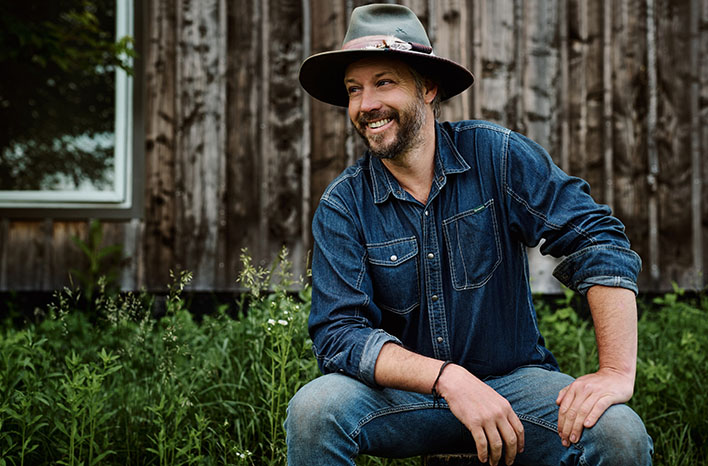
Market gardener Jean-Martin “JM” Fortier’s new book is “In Your Garden: The Complete Guide to Home Vegetable Gardening.” (Photo: Courtesy of JM Fortier & Growers & Co.)
JM lives in Quebec, two miles from the Vermont border and really close to Lake Champlain. “We’re about 50 minutes up north from Burlington, Vermont, and we are 50 minutes down south from Montreal,” he notes, calling it a pretty good growing climate. Not only are the conditions favorable for market farming, so is the community. “We have a lot of folks that are interested in local foods, in organics and just being healthy,” he says. “So we’ve been growing for the community for all these years.”
JM is an eco-entrepreneur who has been a leading voice in the organic and regenerative agriculture movement for more than two decades. His bestselling book “The Market Gardener” has sold more than 250,000 copies worldwide.
Recently, JM was honored with the Meritorious Service Cross by the Governor General of Canada for his contributions to the advancement of regenerative agriculture. His farm-to-table restaurant, Espace Old Mill, was recognized as one of the Top 10 New Restaurants in Canada and awarded a Michelin Green Star for its commitment to sustainable gastronomy. He also co-hosts “The Market Gardener Podcast,” where he engages with leaders shaping the future of small-scale agriculture.
Before jumping into my conversation with JM, I want to pause to remind you that on Wednesday, September 30, I will host “Death in the Garden: Why Your Fall Cleanup Might Be Killing What You’re Trying to Protect” with landscape ecologist, researcher and author Shaun McCoshum, Ph.D. Shaun will show you how to read your garden’s dead and dying vegetation like a habitat map — and how to manage or redesign your space so it looks intentional, not neglected, while doing dramatically more for local wildlife. Registration is $25 plus taxes and fees, and the program will begin at noon Eastern.
Meet Jean-Martin Fortier
“ I didn’t grow up on a farm,” JM shares. He grew up in the suburbs and studied environmental science at university, and when he graduated, he knew he wanted to be involved in something that would be positive and based outdoors.
He and his wife volunteered on a small organic farm in New Mexico and fell in love with the lifestyle. “We came back to Quebec after two years there, and we started our own little project,” he shares. “We lived in a tipi for two years with our kid, and eventually we, we got to buy an old, rabbit barn that we renovated, which is now our little kingdom.”
JM has a huge following around the world of farmers who have adopted his principles and his techniques, and he has taken tried-and-true techniques from people who had preceded him, like Eliot Coleman, and refined those to fit what he’s doing.
JM and his wife, Maude-Hélène Desroches, started their farm Les Jardins de la Grelinette (The Gardens of the Broadfork) in 2004. He wrote his landmark book, “The Market Gardener,” in 2010 and helped to found the research and training farm La Ferme des Quatre-Temps in 2015.
Save Thousands Through Market Gardening Practices
JM says he used my tagline, Grow like a pro™, in promoting his new book, though I don’t mind. He aims to help hobby gardeners learn how small-scale, ecological growing systems can be adapted to backyard spaces.
“ I’ve had a few adventures where I got involved with home gardeners,” he recalls.
For a television show, he helped a young family by teaching them how they could grow food for self-sufficiency.
“ That summer was really amazing because what we did with them was beyond what I would have imagined, and they turned their lawn into something that was producing a lot,” he says.
The kids got involved too and began selling some of what the family was growing. And when they measured the money the family was saving by growing food rather than buying fresh vegetables at a grocery store, it added up to $8,000 worth of production from that project.

A home garden saves money on groceries. The larger and more intensely planted the garden, the more savings there are to be had.
Making a Living as a Market Gardener
“ I grow 60, 70 different vegetables that I bring to market every week,” JM says, “and I don’t have a tractor. I use hand tools, and the garden is under two acres.”
Most new people coming into farming are not from a farming background, and they don’t have 100 acres, tractors and the management skills to hire 50 pickers and handle payroll for that, JM points out.
He wants people to know that on an acre, or even half an acre, a market gardener can net $60,000 or $70,000 a year while feeding the community and enjoying working outside.
He says that idea caught the attention of a lot of people who have always dreamed of being on the land but didn’t want the drudgery of machinery and tractors and Big Farming.
“It captivated the imagination of people,” he says.
He wonders what the world would be like if one in 10 people began growing a garden and creating habitats for butterflies.
“ There’s so much potential for changing the world that way that it’s kind of mind-blowing,” he says.
Biointensive Human-Scale Ecological Farming
Biointensive farming is a term coined in the 1950s in California by growers practicing a farming model that spaces crops as closely together as they can be without compromising their health, while finding the sweet spot where the crops create a canopy that retains moisture and suppresses weeds. “Nature’s soil is always covered,” JM notes.
He says this differs from row cultivation, in which farmers think in terms of tractors rather than in terms of plants.
Biointensive farming requires soil that is loose, deep and biologically active for a lot of fertility that leads to greater yields.
“Then you can have more than one crop per year per bed, so multiplying the density from the surface, but also in time,” JM adds.
“ It’s nothing new under the sun. Growers in France and in Paris were doing this in the 1800s … long before tractors. But it’s something that was kind of rediscovered, and then I took that and perfected it.”
JM grows crops in mounded beds that shed excess water.
He admits that after all these years of always saying, “ Grow better, not bigger,” now he is telling gardeners “Grow bigger.”
“Grow a bigger garden, and don’t work hard,” he explains. “Just grow a bigger garden. Because I was seeing people have gardens that are too small, in my opinion. They could have bigger spaces, they could put green manures, they could do crop rotation, and they could flip things, and with the tools and the techniques that we show them, it’s not more work.”
These days, most people are starting from scratch rather than learning to grow from their grandparents, JM says. They have to learn how much to plant to feed their family over time, how to implement succession planting for continuous harvests.
Though he seeks to maximize the use of space and get the greatest yields, JM does not practice interplanting, or companion planting.
“If you want to calculate your production and have weekly yields, you need to plan it out, and having one bed per crop makes this process so much easier,” he says.
Low-Tech Garden Tool: The Broadfork
A broadfork is like a pitchfork, but with wider tines, a thicker base and double handles. I love my broadfork for loosening up soil in my raised beds.
“ You can open up the soil without inverting the layers,” JM says of using a broadfork.
By contrast, using a rototiller is like putting soil in a blender, which starts loose but ends in soil compaction.
Low-Tech Garden Tool: Bed Preparation Rake
A bed preparation rake is like a regular rake but wider, with narrower tines. JM uses 30-inch beds, so using a 30-inch bed preparation rake helps him maintain the desired size for each bed. And with one pass of the rake, the bed is cleared of debris.
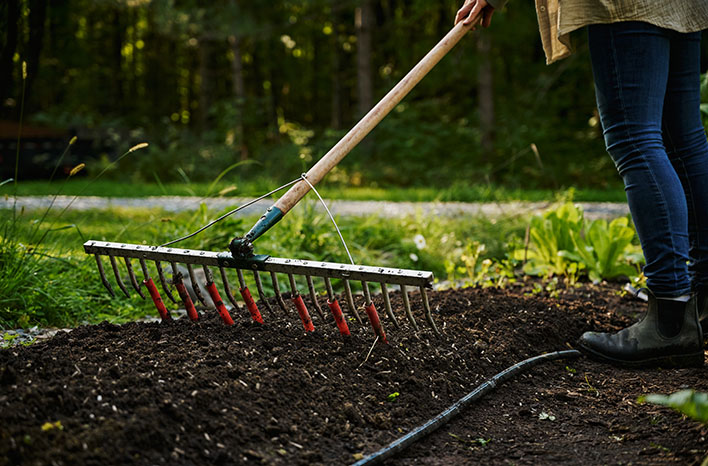
A bed preparation rake is like a regular landscaping rake but wider, with narrower tines. (Photo: Courtesy of JM Fortier & Growers & Co.)
Low-Tech Garden Tool: Katana Hoe
Through his tool company, Growers & Co., JM reimagined the traditional Japanese hoe. Rather than a short shaft, he wanted a tool with a long shaft and a bit of a longer blade with a fine tipping point. He designed what he calls the Katana Hoe.
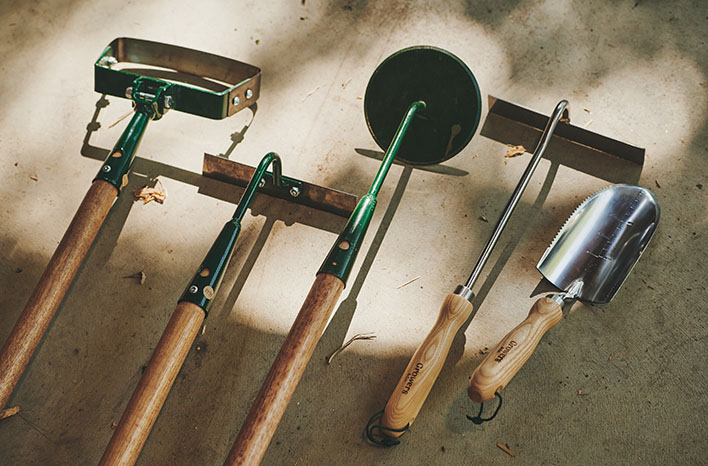
An assortment of tools from Growers & Co. (Photo: Courtesy of JM Fortier & Growers & Co.)
Low-Tech Garden Tool: Stirrup Hoe
A stirrup hoe, also known as a scuffle hoe, is a long-handled tool that makes quick work of weeds.
“That’s the main tool that changes the game for gardeners,” JM says.
It is the preferred way to cultivate the soil because being on one’s knees hand-weeding is inefficient. “ You’ll lose too much money and time.”
By cultivating the soil before weeds get to the two-leaf stage, just moving the soil destroys them, he points out.
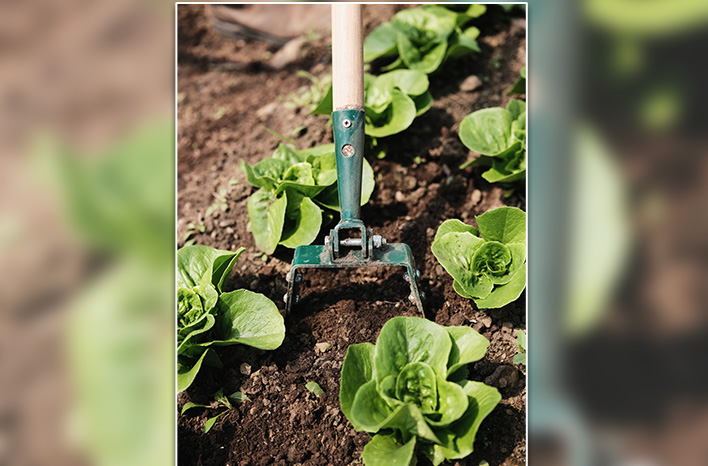
A stirrup hoe is a long-handled tool that makes quick work of weeds. (Photo: Courtesy of JM Fortier & Growers & Co.)
Low-Tech Garden Tool: Collinear Hoe
A collinear hoe slices small weeds just under the soil surface. It has a flat blade with the wedge coming out in the center.
JM likes the collinear hoe because it can get under the canopy and between plants, where a stirrup hoe can’t reach.
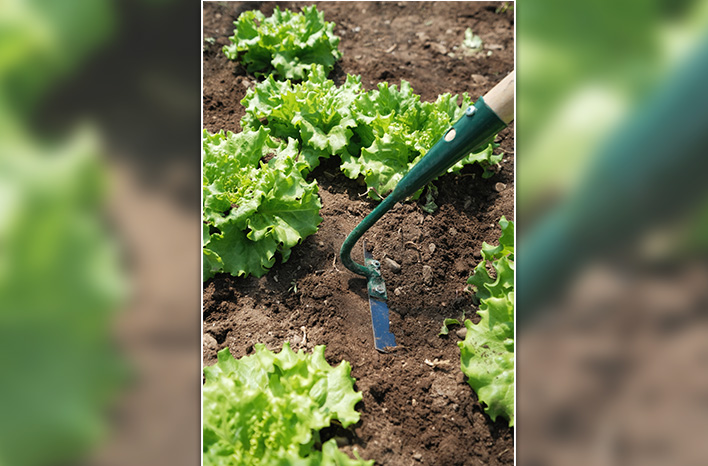
A collinear hoe slices small weeds just under the soil surface. It has a flat blade with the wedge coming out in the center. (Photo: Courtesy of JM Fortier & Growers & Co.)
Crop Rotation in Market Gardening
JM strongly advocates for crop rotation. In biointensive organic farming, it’s a necessity for success.
He explains that when growing the same crops in the same bed over and over, the roots will always be at the same depth and taking nutrients from the same area. They will also always be taking the same nutrients. And if disease patterns emerge, the diseases will keep returning every year.
In crop rotation, changing up which crop type goes in which bed will break pathogen and pest cycles and will withdraw different nutrients from the soil so other nutrients can be replenished over time.
“It starts with a map,” JM says. “You need to have a clear map of your garden, and you should have zones and that map really is how you’ll determine what was there last year, where it’s going to go next year.”
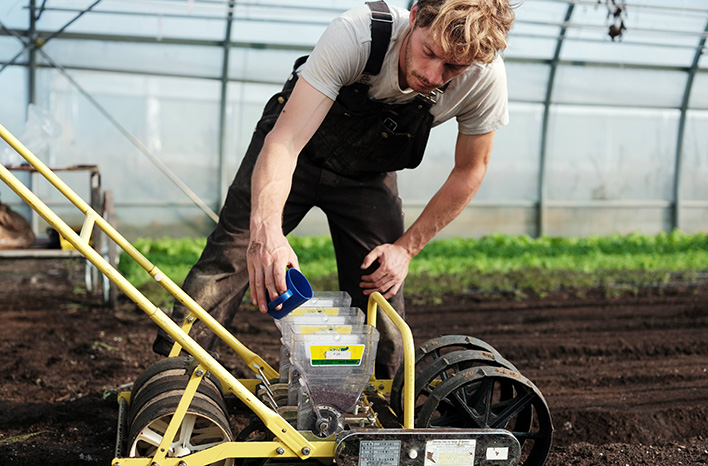
A push seeder is another handy tool for small-scale agriculture. (Photo: Courtesy of JM Fortier & Growers & Co.)
What JM really loves about small-scale agriculture is the ripple effects it has as it inspires others.
“ You can create ecological niches. You can reconnect with soil,” he says. “You can play. You can build habitats. You can observe nature. You can grow food. You can teach this to your kid. You can feed yourself with healthy, vitamin-rich, nutrient-dense food that really makes a big difference for health. You can bring community that way.”
I hope you enjoyed my conversation with Jean-Martin Fortier on market gardening. If you haven’t listened yet, you can do so now by clicking the Play button on the green bar near the top of this post.
Have you practiced market gardening? Let us know in the comments below.
Links & Resources
Episode 088: The New Organic Grower: 50-Years in the Making, with Eliot Coleman
Episode 140: The Successful Journey of a Market Farmer: Conor Crickmore of Neversink Farm
Episode 448: The Self-Fed Garden, with Eliot Coleman
Episode 287: No-Till Gardening and The Living Soil Handbook, with Jesse Frost
Episode 345: The Lean Micro Farm: Raise Crops with Maximum Efficiency
September 30th webinar: “Death in the Garden: Why Your Fall Cleanup Might Be Killing What You’re Trying to Protect”
Fall Gardening Masterclass – Get access to the webinar replay for $20.
joegardener Online Gardening Academy™: Popular courses on gardening fundamentals; managing pests, diseases & weeds; seed starting and more.
joegardener Online Gardening Academy Organic Vegetable Gardening: My new premium online course. The course is designed to be a comprehensive guide to starting, growing, nurturing and harvesting your favorite vegetables, no matter what you love to eat, no matter where you live, no matter your level of gardening experience.
joegardener Online Gardening Academy Master Seed Starting: Everything you need to know to start your own plants from seed — indoors and out.
joegardener Online Gardening Academy Beginning Gardener Fundamentals: Essential principles to know to create a thriving garden.
joegardener Online Gardening Academy Growing Epic Tomatoes: Learn how to grow epic tomatoes with Joe Lamp’l and Craig LeHoullier.
joegardener Online Gardening Academy Master Pests, Diseases & Weeds: Learn the proactive steps to take to manage pests, diseases and weeds for a more successful garden with a lot less frustration. Just $47 for lifetime access!
joegardener Online Gardening Academy Perfect Soil Recipe Master Class: Learn how to create the perfect soil environment for thriving plants.
“In Your Garden: The Complete Guide to Home Vegetable Gardening” by Jean-Martin Fortier
“Microfarms: Organic Market Gardening on a Human Scale” by Jean-Martin Fortier and Aurélie Sécheret
“The Market Gardener: A Successful Grower’s Handbook for Small-Scale Organic Farming” by Jean-Martin Fortier
“Fruiting Vegetables: A Grower’s Guide” by Jean-Martin Fortier
“Tomatoes: A Grower’s Guide” by Jean-Martin Fortier
“Living Soil: A Grower’s Guide” by Jean-Martin Fortier
“The Well Planned Vegetable Garden: A Grower’s Guide” by Jean-Martin Fortier
“Root Vegetables: A Grower’s Guide” by Jean-Martin Fortier
“Vegetable Garden Tools: A Grower’s Guide” by Jean-Martin Fortier
“The Winter Market Gardener: A Successful Grower’s Handbook for Year-Round Harvests” by Jean-Martin Fortier and Catherine Sylvestre
Disclosure: As an Amazon Associate, I earn from qualifying purchases. I receive a commission every time you purchase a product through an Amazon affiliate link. Some product links in this guide are affiliate links. However, none of the prices of these resources have been increased to compensate us, and compensation is not an influencing factor on their inclusion here. The selection of all items featured in this post and podcast was based solely on merit and in no way influenced by any affiliate or financial incentive, or contractual relationship. At the time of this writing, Joe Lamp’l has professional relationships with the following companies who may have products included in this post and podcast: Milorganite, Soil3, Territorial Seed Company, Cool Springs Press / Quarto Group and Dramm. These companies are either Brand Partners of joegardener.com and/or advertise on our website. However, we receive no additional compensation from the sales or promotion of their product through this guide. The inclusion of any products mentioned within this post is entirely independent and exclusive of any relationship.

